


oem coal mining hoses factory Performance Analysis

Introduction
OEM coal mining hoses represent a critical component in the safe and efficient extraction of coal, functioning as the primary conduit for hydraulic power used in a diverse range of equipment including power supports, shearers, conveyor systems, and slurry pipelines. These hoses operate under extremely demanding conditions, characterized by high pressures, abrasive materials, significant temperature fluctuations, and potential exposure to corrosive substances. Unlike standard industrial hoses, coal mining hoses are engineered for superior durability, resistance to specific failure modes common to the underground environment, and adherence to stringent safety regulations. Their technical position within the coal mining industry supply chain is as a specialized, high-reliability component, often customized to specific OEM equipment designs. Core performance characteristics include burst pressure, working pressure, abrasion resistance (measured by rubber hardness and particle impact testing), oil resistance, and resistance to rapid gas decompression (RGD) – a critical safety consideration in underground coal mines. The industry faces ongoing pain points related to hose lifespan, catastrophic failure prevention, and minimizing downtime associated with replacement and repair in hazardous environments.
Material Science & Manufacturing
The construction of OEM coal mining hoses typically involves multiple layers of specialized materials. The inner tube, in direct contact with the hydraulic fluid (often mineral oil-based but increasingly synthetic fluids for extended temperature range), is commonly composed of a nitrile rubber (NBR) compound for oil resistance or a fluoroelastomer (FKM) for wider temperature and chemical compatibility. Reinforcement layers are crucial for withstanding high pressures and are constructed from multiple plies of high-tensile steel wire, often spiraled and pre-stressed during manufacturing. The number and gauge of these steel wires directly correlate to the hose's working and burst pressures. Between the inner tube and reinforcement, a bonding layer (typically a modified NBR) ensures adhesion and prevents separation. The outer cover, providing abrasion and environmental protection, is usually a blend of synthetic rubbers such as Chloroprene (CR) for its resistance to ozone, weathering, and abrasion or a combination of CR and NBR for enhanced oil resistance. Manufacturing processes vary based on hose diameter and construction. High-pressure hoses generally employ a spiral winding process where steel wire is continuously wound around a mandrel, followed by extrusion of the inner tube, bonding layer, and outer cover. Lower pressure hoses may utilize braided reinforcement. Key parameter control during manufacturing includes maintaining consistent wire tension, precise extrusion temperatures and pressures to ensure proper material fusion, and rigorous quality control checks at each stage, including hydrostatic testing to verify burst pressure and impulse testing to simulate dynamic pressure loads. The steel wire used must adhere to standards like SAE J517 for tensile strength and elongation.
Performance & Engineering
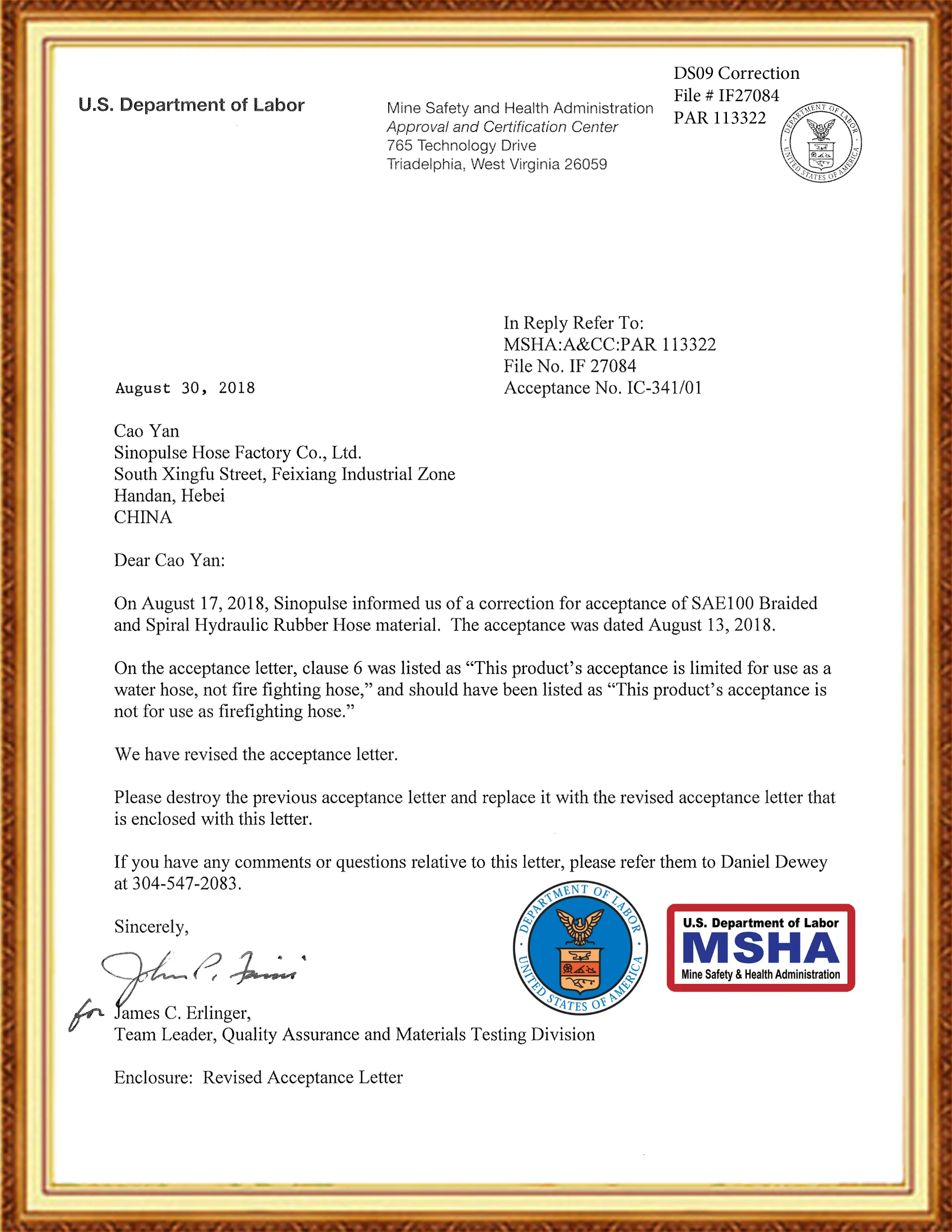
Performance characteristics of coal mining hoses are dictated by a complex interplay of force analysis, environmental resistance, and adherence to strict safety regulations. Force analysis considers not only static working pressure but also dynamic loads caused by pressure pulses, vibration, and potential shock events during operation. Hose designs must account for fatigue induced by these cyclic loads. Environmental resistance is paramount; hoses must withstand exposure to coal dust, water, oils, and varying temperatures, often ranging from near-freezing to elevated temperatures near machinery. RGD is a critical safety concern. Rapid gas decompression occurs when hydraulic fluid under high pressure is suddenly released, potentially causing a violent expulsion of the hose ends. Hose constructions are engineered to minimize RGD risk through secure end fitting attachment and specialized reinforcement configurations. Compliance requirements are substantial. Hoses must meet standards set by organizations like the Mine Safety and Health Administration (MSHA) in the United States, or equivalent regulatory bodies in other mining regions. These standards specify requirements for materials, construction, testing, and marking. Finite Element Analysis (FEA) is frequently used during the design phase to optimize hose geometry and reinforcement patterns for maximum pressure capacity and minimum weight. End fitting selection is also a critical engineering consideration; fittings must be compatible with the hose material and designed to withstand the applied loads without failure.
Technical Specifications
| Parameter | Unit | Typical Value (Low Pressure - Shearer Hose) | Typical Value (High Pressure - Power Support Hose) |
|---|---|---|---|
| Working Pressure | MPa | 10 | 70 |
| Burst Pressure | MPa | 30 | 210 |
| Inner Tube Material | - | NBR | FKM |
| Reinforcement | Layers | 2 Spiral Steel Wire | 6 Spiral Steel Wire |
| Outer Cover Material | - | CR | CR/NBR Blend |
| Temperature Range | °C | -40 to +100 | -40 to +150 |
| Abrasion Resistance (Taber Abrasion Index) | mg Loss | < 50 | <30 |
Failure Mode & Maintenance
Coal mining hoses are susceptible to a range of failure modes. Fatigue cracking, particularly at the hose ends due to cyclic bending and pressure fluctuations, is a common issue. Delamination, the separation of reinforcement layers from the inner tube or outer cover, can occur due to poor bonding during manufacturing or exposure to harsh chemicals. Abrasion, caused by contact with abrasive coal particles or rough surfaces, degrades the outer cover and eventually exposes the reinforcement layers. Oxidation and degradation of the rubber compounds are accelerated by exposure to ozone, UV radiation, and high temperatures. RGD, as previously mentioned, can cause catastrophic hose failure and potential injury. Corrosion of the steel wire reinforcement, though less common, can occur in highly corrosive environments. Maintenance is critical for extending hose lifespan and preventing failures. Regular visual inspections should be conducted to identify signs of abrasion, cracking, or swelling. Hoses should be properly routed to avoid sharp bends and contact with abrasive surfaces. End fittings should be inspected for tightness and corrosion. Hydraulic fluid should be regularly analyzed for contamination, as abrasive particles can accelerate hose wear. Hoses should be replaced at predetermined intervals based on operating conditions and manufacturer recommendations. Proper handling and storage are also essential to prevent damage and degradation.
Industry FAQ
Q: What differentiates a coal mining hose from a standard industrial hydraulic hose?
A: Coal mining hoses are specifically engineered to withstand the harsh conditions of underground mining, including extreme abrasion, rapid gas decompression (RGD), and strict safety regulations like MSHA. They utilize specialized rubber compounds and reinforced constructions not found in standard industrial hoses. Standard hoses lack the robust construction necessary to prevent catastrophic failure in a mining environment.
Q: How critical is RGD resistance in a coal mining hose?
A: RGD resistance is paramount. Sudden hose rupture can release hydraulic fluid at extremely high pressure, posing a severe safety hazard to personnel. Coal mining hose designs incorporate features to minimize RGD risk, such as secure end fitting attachment and specific reinforcement layer configurations.
Q: What is the impact of hose abrasion on operational costs?
A: Abrasion is a major contributor to hose failure in coal mining. Frequent hose replacements due to abrasion significantly increase operational costs, as well as contributing to downtime and production losses. Selecting hoses with highly abrasion-resistant outer covers and implementing proper hose routing are essential for mitigating this issue.
Q: What is the recommended service life for a coal mining hose?
A: Recommended service life varies depending on the specific application, operating conditions, and hose construction. However, as a general guideline, hoses should be inspected and replaced at least annually, or more frequently in severe applications. Detailed monitoring of hose condition and hydraulic fluid analysis are recommended to determine optimal replacement intervals.
Q: How do temperature fluctuations affect hose performance?
A: Extreme temperature variations can cause rubber compounds to expand and contract, leading to stress on the hose structure and potential cracking. Selecting hoses with temperature-resistant materials and ensuring proper temperature control in the hydraulic system are crucial for maintaining hose performance and preventing failures.
Conclusion
OEM coal mining hoses are highly specialized components critical to the safety and efficiency of coal extraction. Their design and manufacture demand a deep understanding of material science, hydraulic engineering, and stringent industry regulations. The selection of appropriate hose constructions, coupled with rigorous maintenance procedures, is paramount for minimizing downtime, preventing catastrophic failures, and ensuring the well-being of mining personnel.
Future advancements in coal mining hose technology will likely focus on the development of even more abrasion-resistant materials, improved RGD mitigation strategies, and the integration of sensor technology for real-time monitoring of hose condition and performance. These innovations will contribute to increased safety, reduced maintenance costs, and enhanced overall productivity in the coal mining industry.