


buy high temperature resistant ptfe hose exporter Performance Analysis
Introduction
High Temperature Resistant PTFE Hose represents a critical component in fluid transfer systems across diverse industries, including chemical processing, automotive, aerospace, and pharmaceutical manufacturing. This guide provides an in-depth technical analysis of these hoses, encompassing material science, manufacturing processes, performance characteristics, failure modes, and relevant industry standards. PTFE (Polytetrafluoroethylene) is selected for its exceptional chemical inertness, wide temperature range (-100°C to +260°C, and higher with specific constructions), and low coefficient of friction. The core challenge in high-temperature applications lies in maintaining hose integrity – preventing permeation, embrittlement, and catastrophic failure. This document aims to equip engineers, procurement managers, and maintenance personnel with the knowledge necessary to specify, implement, and maintain PTFE hose systems effectively, mitigating risks associated with fluid containment and process safety. The industry currently faces a demand for lighter weight, increased flexibility, and longer service life, pushing the boundaries of PTFE hose technology and demanding meticulous attention to construction details.
Material Science & Manufacturing
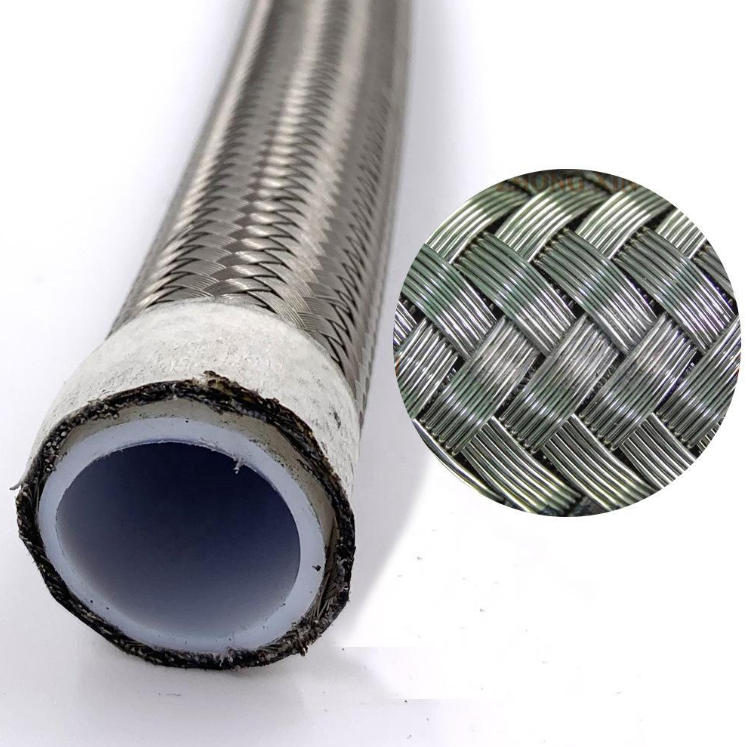
The base material, PTFE, is a fluoropolymer consisting of repeating C2F4 units. Its exceptional properties stem from the strong carbon-fluorine bonds, imparting chemical resistance and thermal stability. However, raw PTFE is difficult to process due to its high melt viscosity. Manufacturing high-temperature PTFE hose typically involves several stages. First, fine PTFE resin powder is selected, often modified with fillers like glass fiber, carbon fiber, or graphite to enhance mechanical strength and reduce creep. The powder is then compacted via extrusion, followed by sintering – a heat treatment process that fuses the particles together without melting. Crucially, sintering parameters (temperature, time, cooling rate) directly influence the final material’s density, crystallinity, and permeability. The hose is then subjected to a multi-layer construction: an inner liner of virgin PTFE for fluid contact, a braided reinforcement layer (typically stainless steel 304/316 or aramid fiber) for pressure resistance, and an outer cover of PTFE or a compatible elastomer for environmental protection. Braid coverage is a critical parameter; higher coverage translates to greater burst pressure capability. Wall thickness is meticulously controlled to balance flexibility and permeation resistance. Post-processing includes dimensional inspection, pressure testing, and leak detection. Ensuring proper adhesion between layers is paramount, often achieved through surface treatment or specialized bonding agents.
Performance & Engineering
Performance of high-temperature PTFE hose is governed by a complex interplay of factors. Burst pressure, determined by the reinforcement braid, is a fundamental metric. However, long-term performance is significantly influenced by creep – the tendency of the hose to slowly elongate under sustained pressure and temperature. Permeation, the diffusion of fluids through the hose wall, is a critical concern, especially with volatile organic compounds (VOCs). Permeation rates are temperature and pressure dependent, following Fick’s Law of Diffusion. Flexibility is often quantified by bend radius; tighter bend radii induce stress concentrations and accelerate fatigue failure. Thermal cycling – repeated exposure to temperature fluctuations – can cause expansion and contraction, potentially leading to cracking or delamination. Finite Element Analysis (FEA) is commonly employed to model hose behavior under various loading conditions, optimizing reinforcement configurations and wall thicknesses. Industry standards like SAE J526 and ISO 6807 specify performance requirements, including burst pressure, pressure drop, and permeation resistance. Furthermore, understanding the chemical compatibility between the hose material and the conveyed fluid is essential to prevent swelling, degradation, or leaching. Special attention must be paid to fluids containing halogenated compounds, as they can permeate through PTFE more readily.
Technical Specifications
| Parameter | Typical Value (Standard Grade PTFE) | Enhanced PTFE (with Fillers) | Units |
|---|---|---|---|
| Operating Temperature | -100 to +260 | -100 to +315 | °C |
| Burst Pressure | 500 | 1500 | psi |
| Working Pressure (1:4 Safety Factor) | 125 | 375 | psi |
| Permeation Rate (VOCs) | 1-10 | 0.1-1 | g·cm-2·day-1 |
| Minimum Bend Radius | 6 | 8 | inches |
| Tensile Strength | 2000 | 4000 | psi |
Failure Mode & Maintenance
Common failure modes in high-temperature PTFE hose include: 1) Permeation Failure: Gradual diffusion of fluid through the hose wall, leading to leakage and environmental contamination. 2) Creep Rupture: Slow elongation under sustained pressure and temperature, ultimately causing fracture. 3) Fatigue Cracking: Initiated by repeated bending and flexing, exacerbated by stress concentrations at fittings. 4) Thermal Degradation: Prolonged exposure to high temperatures can lead to embrittlement and cracking. 5) Delamination: Separation of layers due to inadequate adhesion or thermal stress. 6) Braid Corrosion: Exposure to corrosive fluids can compromise the integrity of the reinforcement braid. Preventative maintenance is crucial. Regular visual inspections should be conducted to identify signs of cracking, swelling, or abrasion. Pressure testing should be performed periodically to verify hose integrity. Fittings should be inspected for tightness and corrosion. When handling PTFE hose, avoid sharp bends and excessive torque during installation. Do not use abrasive cleaning agents, as they can damage the PTFE surface. If the hose is exposed to harsh chemicals, consult a chemical compatibility chart to ensure suitability. Replacement intervals should be based on operating conditions, fluid type, and manufacturer's recommendations. Record keeping of inspection and maintenance activities is essential for tracking hose performance and predicting potential failures.
Industry FAQ
Q: What is the impact of filler materials (glass fiber, carbon fiber) on the performance of PTFE hose?
A: Filler materials significantly enhance mechanical properties like tensile strength and creep resistance. Glass fiber is cost-effective and improves dimensional stability, while carbon fiber offers higher strength-to-weight ratio and improved thermal conductivity, allowing for faster heat dissipation. However, fillers can slightly reduce the chemical inertness of the PTFE and may increase permeability in certain applications. The selection of filler depends on the specific application requirements and fluid compatibility.
Q: How does the braid angle and material affect the burst pressure and flexibility of the hose?
A: A steeper braid angle generally provides higher burst pressure capability, as it distributes the load more effectively. However, a steeper angle reduces flexibility. Stainless steel 304/316 offers excellent corrosion resistance and strength, while aramid fiber provides higher flexibility but lower burst pressure. The optimal braid configuration is a compromise between these factors, tailored to the specific application needs.
Q: What are the primary causes of permeation in PTFE hose and how can it be minimized?
A: Permeation is driven by the concentration gradient between the fluid inside the hose and the surrounding environment. Factors influencing permeation include temperature, pressure, fluid type, and hose wall thickness. Minimizing permeation involves using thicker hose walls, selecting PTFE grades with lower permeability, and utilizing barrier layers (e.g., fluorinated ethylene propylene - FEP). Careful consideration of fluid compatibility is also vital.
Q: How important is proper fitting selection and installation to the long-term performance of a PTFE hose assembly?
A: Proper fitting selection and installation are critical. Fittings must be compatible with PTFE and designed to withstand the operating pressure and temperature. Over-tightening can damage the hose, while under-tightening can lead to leaks. Using appropriate crimping or swaging techniques is essential to ensure a secure and leak-proof connection. Incorrectly installed fittings can create stress concentrations, accelerating fatigue failure.
Q: What considerations should be given when using PTFE hose in vacuum applications?
A: PTFE hose can be used in vacuum applications, but several factors must be considered. The hose must be capable of withstanding the pressure differential, and outgassing of the PTFE material itself can be a concern. Selecting a low-outgassing PTFE grade and pre-baking the hose under vacuum can minimize this issue. The hose must also be resistant to collapse under vacuum pressure.
Conclusion
High Temperature Resistant PTFE Hose represents a sophisticated engineering solution for demanding fluid transfer applications. Its exceptional chemical inertness, thermal stability, and versatility make it indispensable in numerous industries. Achieving optimal performance requires a thorough understanding of material science, manufacturing processes, and failure mechanisms. Careful consideration of parameters such as braid construction, wall thickness, and fluid compatibility is paramount.
Future advancements in PTFE hose technology will likely focus on developing new filler materials to further enhance mechanical properties and reduce permeability. The integration of smart sensors for real-time monitoring of hose condition and pressure will also gain prominence, enabling predictive maintenance and minimizing downtime. Continued research into novel PTFE formulations and processing techniques will drive the development of lighter, more flexible, and longer-lasting hose solutions.